What Is a Rick of Wood? Size, Cords and Price Math
On this page
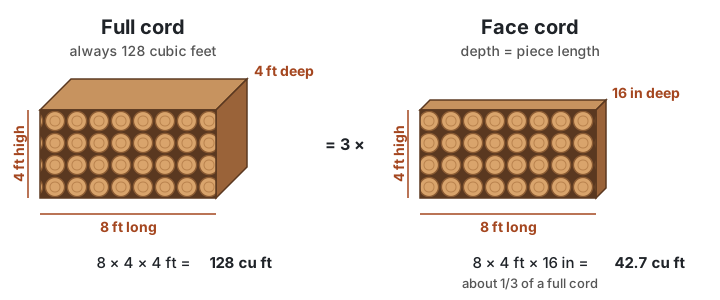
A rick of wood is a stack of firewood that is 4 feet high and 8 feet long, with a depth equal to the length of the pieces. That makes a rick the same thing as a face cord. Other names you may see are rank and stove cord.
The catch is that a rick is not a fixed amount of wood. A full cord is always 128 cubic feet (4 ft × 4 ft × 8 ft). A rick is one 4 × 8 ft face, and the depth is whatever length the seller cuts the pieces. Shorter pieces mean a smaller rick.
How much wood is in a rick?
The math: rick in cubic feet = 4 × 8 × (piece length in inches ÷ 12). Divide by 128 to get the share of a full cord.
| Piece length | One rick holds | Share of a full cord | Ricks in a full cord |
|---|---|---|---|
| 12 in | 32 cu ft | 1/4 | 4 |
| 16 in | 42.7 cu ft | 1/3 | 3 |
| 18 in | 48 cu ft | 3/8 | 2.67 |
| 20 in | 53.3 cu ft | 5/12 | 2.4 |
| 24 in | 64 cu ft | 1/2 | 2 |
A rick of 24-inch wood holds twice as much as a rick of 12-inch wood, yet both can be called "a rick".
Why the price of "a rick" varies so much
Two sellers can both charge for one rick and be selling very different amounts. Always convert to price per full cord before comparing:
price per full cord = price per rick × (128 ÷ cubic feet in the rick)
Here are two offers:
- Seller A: $100 per rick of 12-inch pieces. A cord is 4 ricks, so that is 4 × $100 = $400 per cord.
- Seller B: $160 per rick of 24-inch pieces. A cord is 2 ricks, so that is 2 × $160 = $320 per cord.
Seller B's rick costs more, but you get the wood for $80 less per cord. This only compares volume. Species, dryness and whether the wood is stacked or dumped also change the value. The BTU chart shows how much heat different woods hold.
The same $120 rick gives three different prices per cord:
| Piece length | $120 per rick works out to |
|---|---|
| 12 in | $480 per cord |
| 16 in | $360 per cord |
| 24 in | $240 per cord |
Check what you were actually delivered
- Measure the length and the average height of the stack.
- Measure the piece length on several pieces. Wood sold as 16 inches is often shorter.
- Multiply length × height × (piece length ÷ 12) to get cubic feet, then divide by 128 for the share of a cord.
For example, a stack 8 ft long and 4 ft high of 16-inch pieces is 8 × 4 × (16 ÷ 12) = 42.7 cubic feet, or one third of a cord. The cord calculator does this for any stack size and gives the price per full cord. Only count wood that is stacked tight. A loosely thrown pile holds less wood than its outside size suggests.
Before you buy a rick
- Ask for the piece length and the stack dimensions, not just the word "rick".
- Ask whether the wood is seasoned, and when it was split. See how long to season firewood.
- Ask whether it will be stacked or dumped. A dumped load is hard to measure.
- Rules differ by state. Connecticut, for example, requires fireplace and stove wood to be sold only by the cord, fractions of a cord or cubic meters, and says terms such as "face cord," "rack," "pile" and "truckload" shall not be used (Connecticut Department of Consumer Protection). Your state's weights and measures office can tell you what applies where you live. The face cord vs full cord page covers the same conversion.